The audit and receipts screen from the Churchill console. Every operator action carries a signed receipt, and the chain verifies.
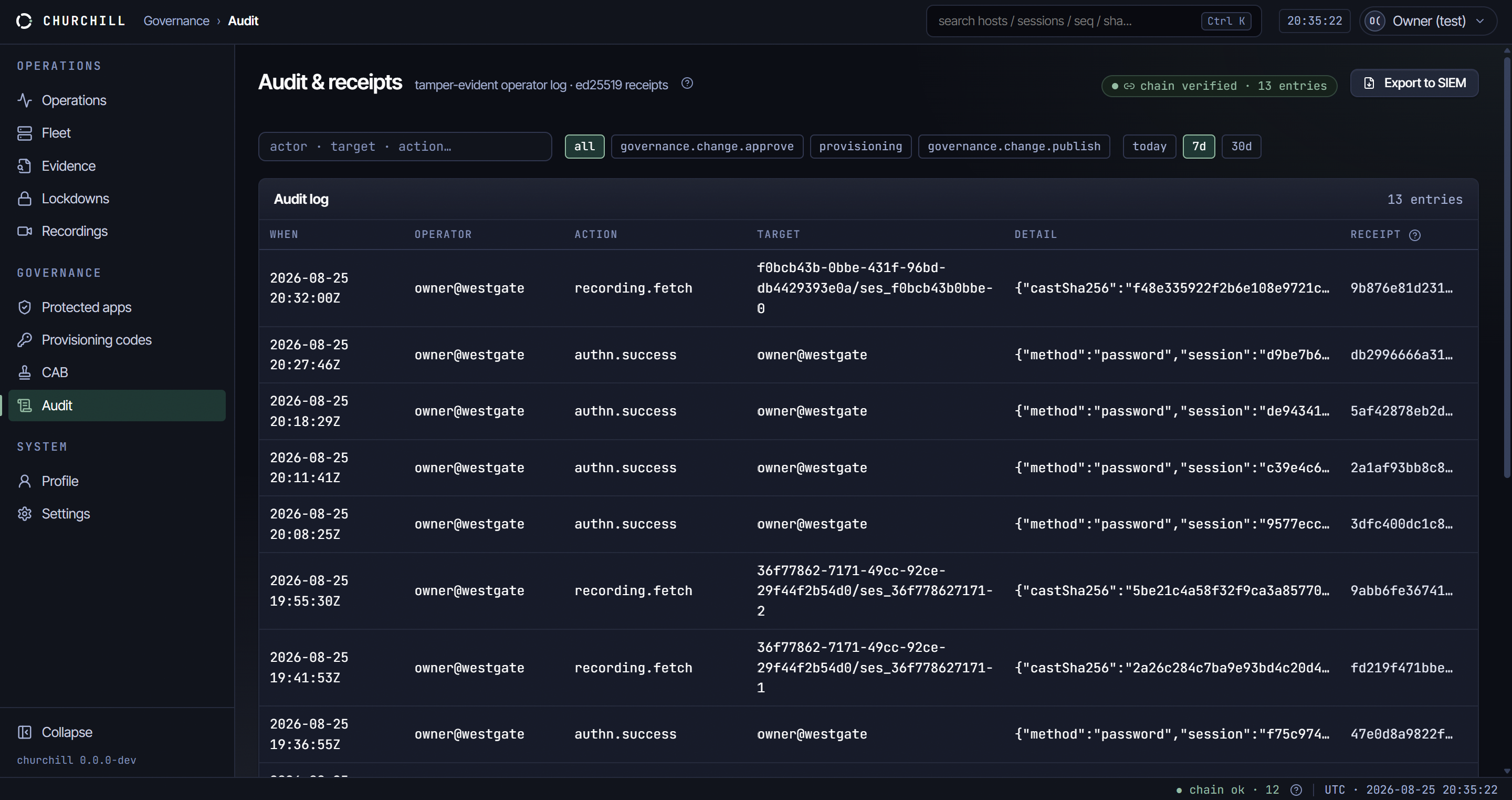
A threat team reads these records to see who is coming for them. A person who co-signs an annual certification reads exactly the same records as continuous, dated, attributed proof that the approved state held. If you are the second reader, start there instead →
Eight teams ask for this record, for eight different reasons.
{{ u.what }}
{{ u.why }}
Everything else in the category records what already happened.
This compares kinds of evidence, not products. Detection and insider-risk tools answer questions Churchill does not: where data moves, how people behave over time, what the network sees. Keep running them. Churchill answers one question they were never built for, and answers it before the change takes effect.
One refused attempt, fully described.
Refuse the unauthorized change, and the intruder's identity stops mattering. Attribution becomes a forensic question you answer from the record, not a guess you make before acting.
{{ analysisText }}
Covering their tracks makes more evidence, not less.
An attacker with root who tries to delete the record of what they just attempted generates another record doing it. The clean-up is itself an event, chained to the one before it and held in a second custody. There is no version of this where they leave less behind by trying.
One record is forensic evidence. A thousand records across your fleet is a map of who is coming for you, and where.
Run Churchill across your protected hosts and the individual refusals become a dataset with structure: by host, by event type, by severity, by account, by hour. Every row is an attack that did not land. The pattern is the intelligence.
Illustrative shape of the data, not a customer environment. Churchill supplies the records, each tied to a host and an account; the reading in the last column is your threat team's, made possible because the underlying facts are no longer in question.
{{ u.name }}
{{ u.body }}
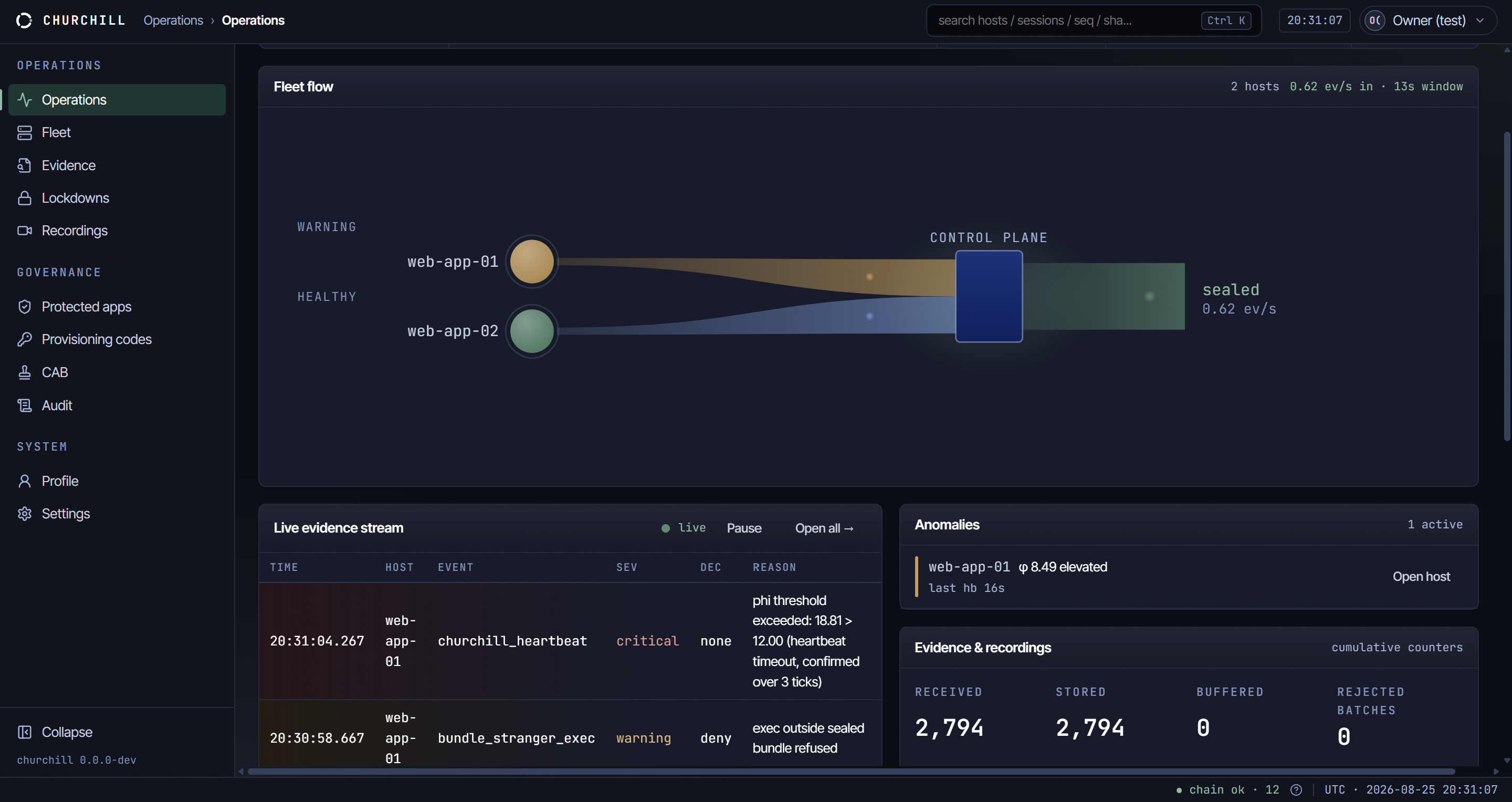
The first security control that makes your institution smarter every time it is attacked.
Detection tools produce alerts, and alerts age out. Churchill builds a record set instead: every attempt on your most critical applications, already decided, already tied to an account, already sealed. It is yours, it stays in your hands, and it grows on its own.
{{ c.name }}
{{ c.body }}
When a human touches a protected host, the session itself becomes evidence. Interactive shell sessions are captured as timestamped terminal recordings, sealed into the same evidence chain, and replayable from the dashboard: live while the actor is still working, or forensically afterward. Your analysts watch the session that never became an incident, keystroke by keystroke, at the speed they choose. Passwords typed at an echo-disabled prompt are masked before they are ever written, so secrets never enter the record.
Session recording on production hosts is a labor-relations question in most jurisdictions and a works-council question wherever one exists. Raise it early. Here is the posture that answers it.
{{ p.v }}
Whether recording is lawful in a given jurisdiction, and what consultation it requires, is a determination for your counsel and your works council rather than for us. What we can do is give them the exact scope in writing during evaluation.
The honest boundary, so your architect does not have to find it.
One question, answered completely: did anyone, or anything, change what your most critical application runs, and can you prove it either way.
See a record from your own environment.
30 days free in non-production. Your first refused attempt is usually the demo.
Try Churchill's Protocol →
Churchill is built and validated on IBM LinuxONE.